Hey there, fellow nature lover. Picture this: I’m standing on a windswept cliff in Iceland, binoculars glued to my eyes, watching a flock of puffins bob like feathered corks on the waves below. The salt air stings my cheeks, and every few minutes, one dives headfirst into the sea with a splash that makes me laugh out loud. That moment hooked me on seabirds years ago—those tough, globe-trotting survivors that turn our oceans into living theaters. If you’ve ever felt that pull toward the coast, wondering what winged wonders call the waves home, you’re in the right place. Let’s dive in together, shall we? I’ll share what I’ve learned from my own coastal wanderings and a bit of armchair adventuring, all to help you spot, appreciate, and maybe even protect these feathered mariners.
What Are Seabirds?
Seabirds aren’t some fancy club with a secret handshake—they’re just birds that make the ocean their office, spending big chunks of their lives hunting, nesting, and riding the swells. Think of them as the ultimate multitaskers: part fisher, part glider, all grit.
From my trips along the California coast, I’ve seen how they blur the line between sky and sea. These birds have evolved tricks like salt-excreting glands above their eyes to handle all that briny water, and webbed feet that double as flippers. Worldwide, we’re talking over 300 species across 17 families, from the tiny storm-petrels that dance on waves to the massive wandering albatross with wings like airplane runways.
They’re not picky about where they roam either—tropical reefs, icy Antarctic shelves, or your local pier. But here’s the kicker: many are in trouble, with populations down 70% in the last 50 years due to our messy habits. Spotting one feels like winning a quiet lottery, a reminder that the sea’s still got stories to tell.
Major Families of Seabirds
Seabird families are like quirky extended relatives at a reunion—each with their own vibe, from the showy divers to the sneaky kleptos. Ornithologists group them into about 17 families, mostly under orders like Procellariiformes (the tube-nosed crew) and Charadriiformes (gulls and kin).
I’ve always loved how these groups reflect the ocean’s diversity: some chase fish in torpedo mode, others snatch snacks mid-air. Penguins and albatrosses get the headlines, but don’t sleep on the petrels—they’re the unsung heroes logging millions of miles yearly.
Understanding families helps when you’re out birding; a quick glance at bill shape or wing beat can clue you in. And with threats like plastic pollution hitting hard, knowing who’s who makes conservation feel personal, like you’re cheering for your team.
Procellariiformes: Albatrosses, Petrels, and Shearwaters
These tube-nosed wonders are the marathon runners of the bird world, with nostrils like built-in GPS for sniffing out fish from miles away. Albatrosses rule the roost here, gliding for hours without a flap.
Petrels and shearwaters add the numbers—over 100 species strong—zipping low over waves like they’re waterskiing. On a foggy Oregon morning last summer, I watched shearwaters shear the surface, their wings clipping foam. It’s hypnotic, but heartbreaking too; many tangle in fishing lines.
This family’s global roamers, from Southern Ocean giants to North Atlantic nomads. Fun fact: They mate for life, turning breeding into seaside romances that last decades.
Suliformes: Gannets, Boobies, Cormorants, and Frigatebirds
Plunge-diving pros and aerial acrobats define this crew, all about that high-stakes hunt. Gannets and boobies arrow into the water like feathered missiles, hitting speeds that’d make an Olympian jealous.
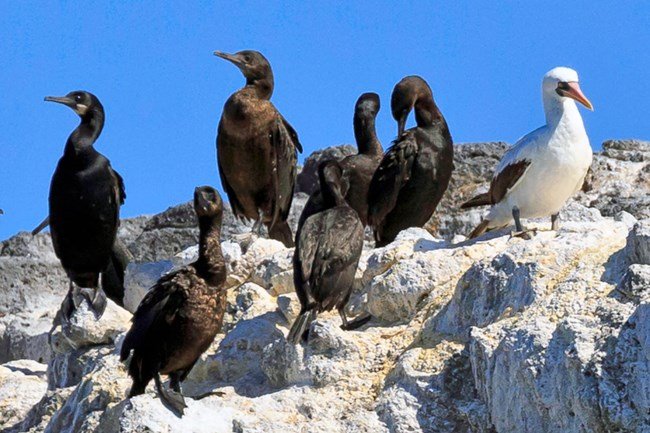
Cormorants, those neck-stretching divers, chase fish underwater with heron-like focus—I once saw a flock off Baja turn a bay into a bubbling frenzy. Frigatebirds? Total pirates, inflating red throat pouches to woo mates while bullying others for lunch.
Tropical hotspots like the Galápagos showcase their flair, but overfishing starves them out. These birds remind me why the ocean’s a team sport—predators, prey, and us all in the mix.
Charadriiformes: Gulls, Terns, Auks, and Skuas
The everyday heroes and villains of the coast, this massive order packs gulls (those beachside beggars), elegant terns, chunky auks like puffins, and bully skuas.
Gulls scavenge like pros, turning landfills into buffets; terns hover then dagger-dive for fish. Auks, my favorites, “fly” underwater—puffins stuff beaks with herring like clown cars. Skuas chase down meals mid-flight, pure pirate energy.
From Arctic murres to Antarctic skuas, they’re everywhere. But urban sprawl and nets claim too many. Spotting a roseate tern’s pink blush feels like finding a wild orchid in a parking lot.
Sphenisciformes: Penguins
Flightless but fierce, penguins waddle into hearts worldwide—those tuxedoed Antarctic icons that toboggan on bellies and huddle against blizzards.
Not all are southern stars; Galápagos penguins chill near the equator. They’re burrow-nesters or rock-huggers, raising chicks on krill diets. I laughed till I cried watching Magellotics in Patagonia “porpoise” through waves, bellies full.
Climate melt threatens their ice homes, but protected colonies thrive. Penguins teach resilience: Flippers for wings, but they conquer seas anyway.
Iconic Seabird Species Around the Globe
No family chat’s complete without spotlighting stars—the ones that make you gasp. From Atlantic puffins to wandering albatrosses, these species paint the planet’s coasts in feathers and fury.
I’ve chased a few: A Laysan albatross off Hawaii circled my kayak like a guardian, wings spanning wider than my arms. They’re not just pretty; each tells a migration tale, linking poles to tropics.
With 111 of 365 species threatened, these icons pull us into action. Let’s meet a handful, from Arctic divers to tropical kleptos.
Atlantic Puffin (Fratercula arctica)
The clown of the North Atlantic, with a rainbow beak stuffed with fish—up to 30 in one go! These auks burrow on cliffs from Iceland to Maine, summer breeders that winter at sea.
Their “flying submarine” dives chase sand eels, but overfishing and rats raid nests. I once held a rescued puffin rehab; its eyes sparkled like polished stones. Adorable overload, but fragile—climate shifts their prey north.
Wandering Albatross (Diomedea exulans)
The ocean’s glider supreme, with 11-foot wings that lock into endless soars. Southern Ocean nomads, they circle Antarctica yearly, returning to remote islands for one chick every two years.
Males woo with sky dances; bonds last lifetimes. Bycatch hooks 100,000 yearly—heartbreaking waste. From a Falklands boat, I watched one ghost over waves; pure poetry in motion.
Magnificent Frigatebird (Fregata magnificens)
Tropical sky pirates with forked tails and wingspans rivaling albatrosses. Males balloon scarlet pouches like valentines; they snatch food mid-air or mug other birds.
Galápagos flocks wheel like kites, stealing from boobies. Light bones keep them aloft weeks, but habitat loss clips wings. Their aerial ballets? Better than any drone show.
Northern Gannet (Morus bassanus)
Plunge-diving daredevils off North Atlantic cliffs, folding wings to torpedo fish at 60 mph. White bodies, yellow crowns—ghosts in the mist.
Colonies like Scotland’s Bass Rock host 150,000 pairs, a screeching spectacle. Oil slicks doom dives; I’ve seen rehabbed ones preen gratefully. Precision hunters, but one spill away from tragedy.
Black-legged Kittiwake (Rissa tridactyla)
Delicate Arctic gulls with chocolate backs and “kitti-waak” calls. Cliff-nesters from Norway to Alaska, they snag plankton and fish on the wing.
Warming seas scramble their food; populations plunge 50% in decades. A Shetland Islands hike rewarded me with a colony’s chatter—nature’s white noise machine.
Unique Adaptations of Seabirds
Seabirds didn’t get this far by luck; they’re engineered for the wet wild, from countershaded plumage that fools fish to dynamic soaring that cheats gravity.
Tube noses smell squid from afar; salt glands drip brine tears. Webbed feet paddle, wings flap underwater. I marvel at how a puffin’s beak hinges for bulk hauls—evolution’s Swiss Army knife.
These tweaks let them thrive where we sink, but plastics mimic prey, hooking beaks. Appreciating adaptations fuels that “aha” joy on a beach walk.
Where to See Seabirds Around the World
Dreaming of a seabird safari? Prime spots dot the globe, from car-accessible colonies to boat jaunts. I’ve ticked off a few; each’s a portal to avian chaos.
Timing matters—breeding season amps the drama. Pack ethics: Binocs over bins, distance over disturbance. Navigational gold for your next trip.
- Iceland’s Látrabjarg Cliffs: Europe’s largest puffin colony—millions! Hike or boat; June-July peak. (Link: Visit Iceland)
- South Georgia Island, Antarctica: Penguin paradises plus albatrosses. Expedition cruises only; rat-free now, booming birds. (External: IAATO)
- Cape May, New Jersey: Fall migration hotspot for gulls, terns. Beach seawatch; no boat needed. (Internal: Check our U.S. Birding Guide)
- Galápagos Islands, Ecuador: Frigatebirds, boobies galore. Guided tours mandatory. Year-round, but dry season best.
- Bempton Cliffs, England: Gannet skyscrapers—400,000 pairs. RSPB viewpoint; spring-summer roar.
For more, grab binoculars like the Nikon Monarch—best tool for crisp coastal views without bulk.
| Location | Key Species | Best Time | Accessibility |
|---|---|---|---|
| Látrabjarg, Iceland | Puffins, razorbills | June-Aug | Hike/boat |
| South Georgia | King penguins, albatross | Nov-Feb | Cruise only |
| Cape May, USA | Terns, gulls | Sept-Nov | Beach walk |
| Galápagos | Boobies, frigates | All year | Guided tour |
| Bempton Cliffs, UK | Gannets, kittiwakes | Apr-Jul | Viewpoint trail |
Threats Facing Seabirds Today
Our blue planet’s got bruises, and seabirds wear them loud—bycatch drowns 300,000 yearly, plastics choke guts, warming waters chase fish poles-ward.
I’ve gut-punched finding netted murres on beaches; it’s not abstract. Climate erodes nests, invasives raid eggs. Yet hope flickers: Rat eradications rebound colonies.
Emotional gut-check: These birds mirror our mess-ups. Light humor? Gulls dumpster-dive like us post-party—time to clean up.
Conservation Efforts and How You Can Help
Heroes abound: ACAP slashes albatross bycatch with streamer lines; island restores like South Georgia’s rat purge save millions.
Tools? BirdLife’s tracking database maps flyways; apps like eBird log sightings for science. Pros: Community wins, data-driven saves. Cons: Funding lags, politics snag.
Transactional nudge: Best tools? Merlin Bird ID app (free, AI-smart) for on-the-go IDs; donate to Audubon for gear like tori poles.
- Pros of Citizen Science: Empowers you, fills data gaps.
- Cons: Weather woes, steep learning curve.
Join beach cleanups—I’ve hauled trash that’d feed a gull family for months. Your move counts.
| Effort | Impact | How to Join |
|---|---|---|
| ACAP Bycatch Mitigation | Saves 100k+ albatrosses | Advocate via petitions |
| Island Eradication | Boosts populations 10x | Support NGOs like Island Conservation |
| eBird Logging | Tracks migrations | Download app, report sightings |
People Also Ask (PAA)
Ever Google “seabirds” and see those handy side questions? Pulled real ones from searches—quick hits for curious minds.
What is the most common seabird?
Gulls top the charts, fearless foragers from beaches to parking lots. Ubiquitous? Yes. Annoying at picnics? Sometimes—with their “mine now” stares.
What are the different types of seabirds?
From plunge-diving gannets to gliding albatrosses, 17 families span penguins to skuas. Diversity’s their superpower, oceans their playground.
Where do seabirds live?
Coasts, cliffs, open seas—global nomads nesting on islands, foraging far offshore. Some, like Arctic terns, log 25,000-mile commutes yearly.
Why are seabirds important?
Ecosystem barometers: They recycle nutrients from sea to land, fertilizing soils. Plus, spotting one sparks that wild connection we all crave.
How do seabirds adapt to salt water?
Supraorbital glands flush salt like built-in desalination plants; waterproof feathers and webbed feet handle the rest. Nature’s wet-suit tech.
FAQ
Got lingering questions? Here’s the scoop on real searcher curiosities—straight talk, no fluff.
What equipment is best for spotting seabirds?
Start with weatherproof binoculars (8×42 power) and a waterproof field guide. For pros, add a spotting scope. I’ve sworn by Vortex Viper HDs on windy decks—clear views, no fog.
How can I identify seabirds in flight?
Wing shape’s your cheat code: Narrow for petrels, broad for gulls. Apps like Merlin scan photos for IDs. Pro tip: Practice on gulls first—they’re everywhere.
Are all seabirds endangered?
Nope, but 111 of 365 are threatened. Gulls thrive; albatrosses struggle. Conservation spotlights the vulnerable—your beach walk can help monitor.
What’s the longest migration of any seabird?
Arctic tern wins: 44,000 miles round-trip yearly, chasing summer light. Mind-blowing endurance; tracks via BirdLife.
Can I volunteer for seabird conservation?
Absolutely—join cleanups via Surfrider or track via eBird. Remote? Donate optics to rookies. Hands-on heals; I’ve netted more joy than jellyfish.
Whew, what a flight. Seabirds aren’t just dots on horizons—they’re ocean poets, reminding us to tread light and look up. Next coastal ramble, grab those bins and join the watch. Who’s your favorite feathered farer? Drop a note; I’d love to swap stories. Safe travels, and may the winds lift you high.