Picture this: It’s a balmy afternoon off the coast of Bali, and I’m floating face-down in the turquoise shallows, heart pounding like a drum in my chest. My snorkel mask fogs slightly from my excited breaths as a shadow glides beneath me—massive, graceful, like a living kite dancing on invisible strings. That’s my first encounter with a manta ray, back in 2018 during a solo backpacking trip that changed how I see the ocean. These incredible sea rays aren’t just fish; they’re the ocean’s quiet poets, soaring through water with an elegance that makes you forget you’re holding your breath. As someone who’s logged hundreds of dive hours from the Great Barrier Reef to Mexico’s Riviera Maya, I’ve chased these flattened wonders across continents. They’re not flashy like clownfish or fierce like great whites, but there’s something profoundly humbling about them. In this week’s lifeform spotlight, we’ll dive deep—pun intended—into what makes sea rays so captivating, from their ancient lineage to the spots where you can meet them yourself. Whether you’re a armchair adventurer or plotting your next underwater quest, stick around. You might just find yourself booking a ticket to the tropics by the end.
What Exactly Are Sea Rays?
Sea rays, those diamond-shaped drifters of the deep, belong to the superorder Batoidea within the class Chondrichthyes—the same cartilaginous crew as sharks. Unlike bony fish, they’ve got skeletons made of flexible cartilage, no scales, and skin that’s often as rough as sandpaper. But what sets them apart is their flattened bodies, evolved for life hugging the seafloor or filtering plankton mid-water. I’ve always thought of them as the ocean’s stealth bombers—silent, efficient, and utterly mesmerizing when they unfurl those wing-like pectoral fins.
Their Evolutionary Roots
Rays trace their lineage back over 150 million years to the Jurassic period, branching off from early sharks that decided bottom-dwelling was the way to go. Fossil records show their ancestors were already experimenting with that disc-shaped body, perfect for ambush hunting in ancient seabeds. It’s wild to think these guys predate dinosaurs in some ways, adapting through mass extinctions while sharks stuck to the torpedo shape.
Body Structure and Adaptations
At first glance, a ray’s body screams efficiency: eyes and spiracles (water-breathing holes) perched on top for spotting threats, mouth and gills tucked underneath for vacuuming up meals. That whip-like tail? It’s not just for show—many pack a venomous barb for defense. No bones mean they’re lightweight gliders, but it also makes them vulnerable to overfishing since they heal slowly from injuries.
The Diversity of Sea Rays: Types and Varieties
With over 600 species worldwide, sea rays come in flavors as varied as a seafood platter—from the filter-feeding giants to the spiny bottom-huggers. Each type has carved out a niche, whether it’s patrolling coral reefs or zipping through open ocean currents. Spotting the differences on a dive is like a game of underwater I Spy; get it right, and you feel like a marine detective.
Here’s a quick rundown of some standout types, pulled from my field notes and a few trusted guides:
| Type | Max Size (Wingspan) | Habitat | Fun Fact |
|---|---|---|---|
| Oceanic Manta Ray (Mobula birostris) | Up to 7m (23 ft) | Open ocean, tropical waters | World’s largest ray; filter-feeds on plankton like a gentle vacuum. |
| Reef Manta Ray (Mobula alfredi) | Up to 5.5m (18 ft) | Coastal reefs, Indo-Pacific | Loves cleaning stations where fish nibble parasites off its belly. |
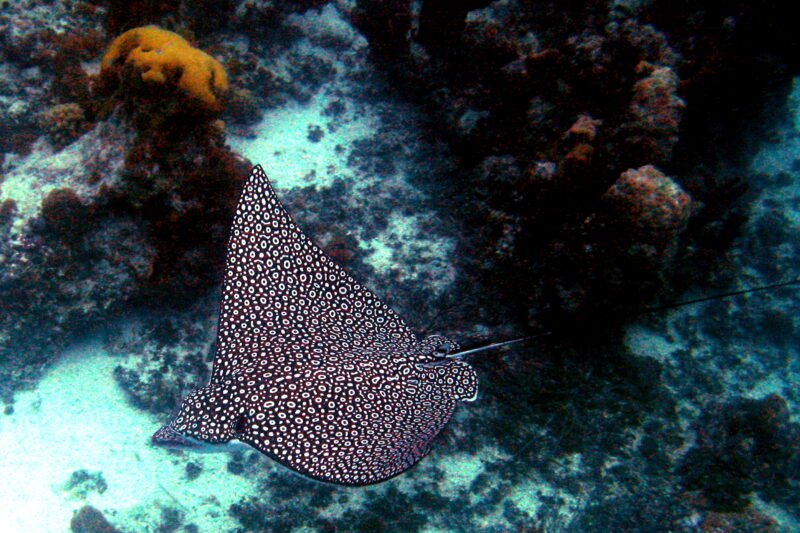
| Spotted Eagle Ray (Aetobatus narinari) | Up to 3m (10 ft) | Coral reefs, sandy bottoms | Those white-spotted wings make it look like a polka-dotted UFO. |
| Southern Stingray (Hypanus americanus) | Up to 2m (6.5 ft) | Shallow coastal waters, Caribbean | Masters of camouflage, blending into sand like nature’s doormat. |
| Blue-Spotted Stingray (Taeniura lymma) | Up to 70cm (2.3 ft) | Indo-Pacific reefs | Electric blue spots that glow under UV light—party animals of the sea. |
| Electric Ray (Torpedo spp.) | Up to 1.8m (6 ft) | Sandy bottoms, temperate to tropical | Zaps prey with shocks up to 220 volts; basically underwater tasers. |
This table scratches the surface—eagle rays leap like acrobats, while butterfly rays flap those wide wings for short bursts of speed. If you’re into visuals, check out this infographic from Citrus Reef for more eye candy.
Habitat and Where to Spot These Underwater Wonders
Sea rays thrive in warm, shallow waters from coral-fringed atolls to murky estuaries, but each species has its sweet spot—mantas in nutrient-rich currents, stingrays in silty shallows. Climate change is shifting those boundaries, pushing some toward cooler poles, but for now, the tropics are their playground. I’ve learned the hard way: patience pays off when staking out a ray hangout.
Want to chase them yourself? Here are top navigational picks based on reliable dive reports:
- Bali, Indonesia: Manta Point near Nusa Penida—night dives draw reef mantas like moths to a flame.
- Great Barrier Reef, Australia: Lady Elliot Island for eagle rays cruising the bommies.
- Cozumel, Mexico: Stingray Beach for shallow swims with southern stings (barbs filed for safety).
- Maldives: Hanifaru Bay, a UNESCO site where mantas barrel-feed in vortexes of plankton.
- Hawaii, USA: Kona’s night manta snorkels—touristy but magical, with lights attracting the giants.
Pro tip: Book with eco-certified operators via PADI’s dive center locator to keep it sustainable. And if aquariums are more your speed, Georgia Aquarium’s massive manta tank is a solid stateside alternative.
Behavior and Daily Life in the Deep Blue
Rays aren’t the loners you might imagine; many form loose schools for feeding frenzies or migration marathons, communicating through subtle fin flicks and body undulations. They’re crepuscular mostly—dawn and dusk hunters—resting buried in sand by day. Watching a manta somersault to dislodge remoras feels like peeking into a secret ballet.
Hunting and Feeding Habits
Most rays are bottom-scavengers, using electroreceptors to sense buried clams or crabs, then “flying” over to suck them up with a powerful jaw vacuum. Mantas, though? They’re the oddballs, barrel-rolling through plankton blooms with mouths agape like living nets. Diet-wise, it’s a buffet of mollusks, crustaceans, and small fish—up to 25% of their body weight daily for the big ones. I once saw a spotted eagle ray unearth a whole sand flat in the Caymans; it was like tilling a garden, but with style.
Social Interactions and Reproduction
Rays court with nips and tail chases—males get bitey, females play hard to get. They give live birth to mini-me’s after 4-12 months gestation, no parental doting afterward. Emotional hook: Those pups emerging fully formed? It’s nature’s way of saying “sink or swim,” but with a 50% survival boost from mom’s nutrient yolk.
Fascinating Facts About Sea Rays
Rays pack more surprises than a beachcombing haul. Here’s a bullet list of my favorites, gleaned from dives and dusty field guides—guaranteed to wow at your next dinner party:
- Rays have no bones, just cartilage—like flexible shark skeletons on a diet.
- Some electric rays zap with 200+ volts, enough to stun a human (but they rarely do; drama queens).
- Manta brains weigh 70g—big for fish—hinting at smarts rivaling dolphins.
- They replace teeth like we change socks, shedding hundreds yearly for that grinding edge.
- Camouflage pros: Stingrays shift sand over themselves, vanishing like magic tricks.
- Lifespan champs: Mantas hit 50 years, outliving many humans’ pet goldfish.
- No swim bladders means constant motion, or they sink—talk about commitment issues.
- Some species leap 2m out of water, possibly to shake parasites or signal mates (acrobatic therapy?).
- Venom barbs regrow, but stings feel like hot pokers—Steve Irwin’s legacy reminds us to shuffle, not stomp.
- They’re ecosystem engineers, aerating sediment to boost tiny critter habitats.
Humor break: If rays had Yelp reviews, it’d be five stars for “gliding” but one for “tail-whipping customer service.”
Sea Rays vs. Sharks: Close Cousins or Worlds Apart?
Rays and sharks share DNA but diverged like siblings who took different career paths—one went corporate (streamlined predator), the other bohemian (flattened forager). Both elasmobranchs, sure, but rays traded speed for stealth. Here’s a side-by-side to settle the family feud:
| Feature | Sea Rays | Sharks |
|---|---|---|
| Body Shape | Flattened disc for bottom life | Torpedo for cruising depths |
| Fins | Wing-like pectorals for “flying” | Dorsal and anal for stability |
| Tail | Whippy, often barbed | Heterocercal (upper lobe bigger) for thrust |
| Teeth | Flat grinders for crushing shells | Serrated slicers for tearing flesh |
| Senses | Ampullae for buried prey detection | Same, plus keen smell for blood trails |
| Reproduction | Live birth, 1-15 pups | Mostly live, some egg cases |
| Speed | Up to 10 mph in bursts | 20+ mph for chases |
Bottom line: Rays are the chill artists; sharks, the intense hunters. Both vital for balance—lose one, the other’s menu gets weird.
Conservation Challenges Facing Sea Rays
Overfishing for gill plates (used in bogus “health” tonics) and bycatch in trawls have slashed populations by 50% in decades. Mantas, with slow maturity (8-10 years), rebound like molasses. But tourism flips the script: Responsible encounters fund patrols. I’ve donated dive fees to Manta Trust—feels good knowing my splash helps.
Pros and Cons of Ray Tourism
- Pros: Generates $100M+ yearly for locals; educates on threats; non-invasive if regulated.
- Cons: Crowds stress animals; flash photography blinds; cheap ops ignore barbs.
Opt for CITES-compliant spots—global bans help, but local enforcement lags.
Getting Up Close: How to Dive with Sea Rays Safely
Transactional intent? Gear up right, and you’ll snag encounters without the ouch. From my kit: A rash guard for stings, booties for shuffle-stepping. Best tools? Here’s a curated list for beginners eyeing that Bali trip:
- Mask and Snorkel: Cressi Big Eyes—wide view for spotting shadows ($50).
- Fins: Mares Avanti Quattro—powerful yet quiet ($120).
- Wetsuit: 3mm shorty for warmth and rash protection ($80).
- Dive Light: Night mantas demand one; Orcatorch D550 ($70).
- GoPro Hero: Capture the glide—waterproof to 10m ($300).
Bundle via Scuba.com’s ray-focused packs—saves 20%. Safety first: No touching, maintain distance, support NOAA’s recovery plans.
People Also Ask
Google’s “People Also Ask” bubbles up real curiosities—here’s the scoop on top queries, snippet-style for quick hits.
What’s the difference between manta rays and stingrays?
Manta rays are filter-feeders with no stingers, soaring open water up to 7m wide; stingrays hug bottoms, pack venom barbs, and max at 2m. Mantas are the gentle giants; stings, the prickly neighbors.
Are sea rays dangerous to humans?
Rarely—stings hurt like bee jabs but rarely fatal (antivenom exists). Mantas? Zero threat; they’re curious, not cranky. Shuffle feet to avoid surprises.
What do sea rays eat?
Bottom-dwellers crush mollusks and crabs; mantas slurp plankton. It’s a spectrum from vacuuming sand to somersaulting through krill clouds.
How long do sea rays live?
Mant as hit 50 years; stings, 15-25. Slow growers mean slow recoveries—why conservation matters.
Can you swim with sea rays?
Absolutely, in spots like the Maldives. Snorkel ethically; no chasing. It’s transformative, like hugging the ocean.
FAQ
Got lingering questions? These pop up in my inbox post-dive chats—straight answers from the blue.
Q: How can I tell if a ray is a manta or eagle?
A: Mantas have horn-like cephalic fins for funneling food; eagles sport a duck-bill snout and spotted backs. Size helps—mantas dwarf most.
Q: Are all sea rays venomous?
A: No, only stingrays and relatives; mantas and skates skip the barb. Electric rays shock instead—nature’s variety pack.
Q: What’s the best time of year for ray diving?
A: Dry season in tropics (May-Oct for Indo-Pacific). Plankton blooms draw mantas; check Manta Ray Advocates for seasonal maps.
Q: How does climate change affect sea rays?
A: Warmer waters disrupt prey; acidification softens shells they crunch. Mantas migrate farther, stressing populations.
Q: Can I adopt or sponsor a sea ray?
A: Yes! Groups like Save Our Seas let you fund tracking tags. It’s $50/year for real impact.
There you have it—sea rays unpacked, from their sandy siestas to sky-high leaps. That Bali shadow still haunts my dreams, a reminder of oceans teeming with quiet miracles. If this sparked your wanderlust, drop a comment: What’s your wildest underwater tale? Dive safe, friends—the sea’s waiting.