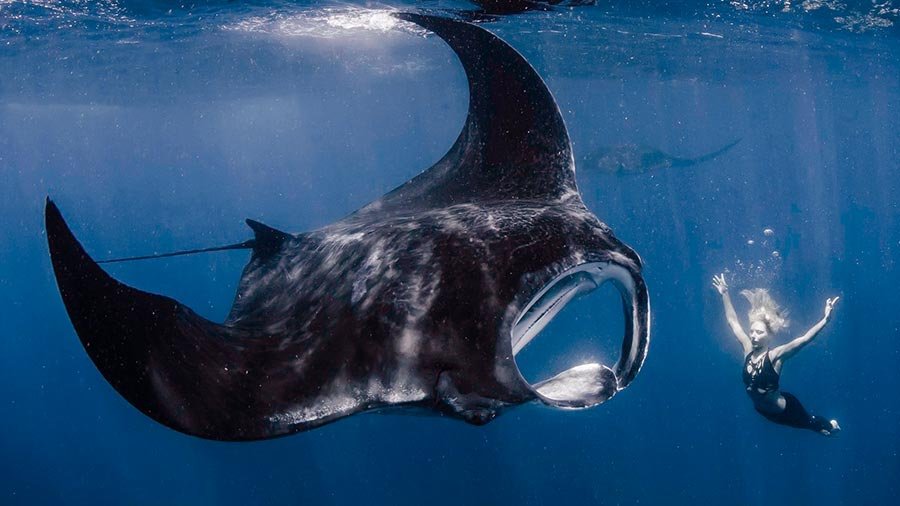
Picture this: It’s a balmy afternoon off the coast of Hawaii, the kind where the sun kisses the waves just right, turning the ocean into a shimmering blue dream. I’m floating there, snorkel in mouth, heart pounding like a drum in my chest—my first real encounter with a giant manta ray. This massive creature glides beneath me, wings spanning wider than my arms stretched out, looking every bit the peaceful wanderer I’d read about. No sharp teeth, no aggressive charge, just this serene ballet through the water. I felt a rush of awe, like I’d stumbled into a secret underwater world. Little did I know then, that “gentle giant” was more myth than fact. Turns out, these rays aren’t just drifting poets of the sea; they’re cunning predators, plunging into the ocean’s shadowy depths to hunt. That 2016 discovery flipped the script on everything we thought we knew, and it’s reshaped how we protect them. Stick with me as we dive deeper—pun intended—into the hidden life of these oceanic enigmas.
Unmasking the Gentle Giant: What Are Giant Manta Rays?
For years, folks like me who’ve spent hours peering through masks into the blue have called giant manta rays the ocean’s pacifists. But labels stick, even when they’re half-true. Scientifically known as Manta birostris, these filter-feeders can stretch up to 23 feet across, making them the largest rays on the planet. They’re not your average bottom-dwellers; they soar through open water like living kites, powered by those enormous pectoral fins that flap with effortless grace.
What sets them apart is their intelligence—yes, rays have brains bigger than most fish, hinting at complex behaviors we’ll unpack soon. I’ve chased their shadows on dives from Indonesia to Mexico, always struck by how they seem to sense your presence, curving away not in fear, but curiosity. It’s that almost-human vibe that hooks you, turning a simple swim into something profound.
Anatomy of a Leviathan
Break down a giant manta, and you’re looking at evolution’s clever workaround for survival. No stinging tail barb like their stingray cousins—just a tail that’s more rudder than weapon. Their heads sport cephalic fins that curl like horns, funneling food straight into that cavernous mouth lined with gill rakers finer than a coffee filter. Those rakers trap tiny prey while letting water rush out, a setup perfect for the deep dives we’ll talk about.
I once surfaced from a dive in the Galápagos, fins aching, replaying the sight of one ray’s underbelly: pale white with black shoulder patches, like a secret tattoo only the sea gets to see. It’s details like that— the subtle ventral spots used for ID, much like our fingerprints—that make tracking these nomads possible. No wonder researchers geek out over them; every fin flap tells a story.
Global Wanderers: Habitat and Range
These rays don’t settle down; they’re citizens of the sea, roaming tropical and subtropical waters worldwide. Think Indo-Pacific hotspots like the Maldives or the Gulf of Mexico—places where warm currents meet nutrient upwellings. They hug coastlines for cleaning stations but venture far offshore, sometimes crossing entire oceans in migrations that boggle the mind.
On a trip to Ecuador’s Isla de la Plata, I watched a pod—yes, they school loosely—circle a reef, their silhouettes backlit by the sun. It’s magical, but fragile; warming oceans push them toward poles, shifting ranges faster than we can map. Climate change isn’t just buzzwords here—it’s reshaping their world, one degree at a time.
The Surprising Reveal: Giant Rays as Deep-Sea Predators
Remember that peaceful glide I mentioned? It turns out, it’s just the appetizer. Back in 2016, a team from the University of Queensland dropped a bombshell: giant mantas aren’t surface loafers. They’re deep divers, snagging most meals from the mesopelagic zone— that twilight realm 200 to 1,000 meters down where light fades and pressure cranks up. This flipped our view from “harmless drifters” to “strategic hunters,” revealing a side as thrilling as it is vital for their survival.
The study wasn’t some lab hunch; it came from real fieldwork off Ecuador, where researchers darted tiny biopsies from free-swimming rays. No harm, all insight. What they found? These “gentle” giants are pros at vertical foraging, rocketing down on schools of fish and crustaceans invisible from the surface. It’s like discovering your quiet neighbor moonlights as a marathon runner—unexpected, but it explains so much about their endurance and those marathon migrations.
The Groundbreaking 2016 Study
Led by Katherine Burgess and crew, this research hit the Royal Society Open Science like a depth charge. Using stable isotope analysis—think chemical fingerprints in muscle tissue—they traced diets back to source. Turns out, 73% of a manta’s calories hail from deep-sea fare, not the plankton blooms we assumed dominated. Only 27% from surface stuff. It’s a game-changer, proving these rays bridge ocean layers in ways we never clocked.
I read the paper on a rainy night in my dive shack, highlighter flying. The non-invasive methods? Genius—darts fired from boats, samples smaller than a pencil eraser. It spared these vulnerable critters stress, setting a gold standard for megafauna studies. If you’re into marine bio, check the full study here—it’s a blueprint for ethical science.
How They Hunt in the Abyss
Diving deep isn’t casual for mantas; it’s a calculated plunge. They barrel down headfirst, mouth agape, using bioluminescence from prey as a beacon in the dark. Once locked on, those cephalic fins herd schools into a frenzy, turning the ray into a living vacuum. It’s not chomping—it’s strategic sieving, expelling water through gills while gobbling the goods.
Humor me for a sec: Imagine flipping your house upside down to vacuum under the couch. That’s mantas in the deep—efficient, but exhausting. My own dives rarely hit those depths, but tagging data from pros shows they hold breaths for 15 minutes, surfacing only when lungs scream. It’s this adaptability that makes them survivors, yet so tuned to ecosystems we barely grasp.
| Feeding Zone | Primary Prey | Proportion of Diet | Dive Depth |
|---|---|---|---|
| Surface (Epipelagic) | Zooplankton (copepods, krill) | 27% | 0-200m |
| Mesopelagic (Deep) | Mysids, small fish, decapod larvae | 73% | 200-1,000m |
This table highlights the split—surface skimming versus deep predation—based on isotope data. Notice how the deep dominates? It’s why protecting those hidden layers matters as much as reefs.
A Peek into Their Menu: What Do Giant Manta Rays Eat?
Plankton gets the spotlight, but let’s dish on the full spread. Giant mantas are filter-feeder extraordinaire, slurping up to 60 pounds of tiny critters daily. Surface snacks include euphausiids and copepods—those itty-bitty drifters that bloom in currents. But the deep-sea haul? That’s where the protein packs in: larval shrimp, mysid shrimp, even juvenile fish too slow to scatter.
- Zooplankton staples: Copepods and krill, easy surface grabs that fuel quick energy.
- Deep divers’ delight: Decapod larvae and small mesopelagic fish, richer in fats for those long hauls.
- Occasional extras: Bivalve larvae or fish eggs, opportunistic picks during migrations.
I chuckle thinking of it— these behemoths, picky eaters in a buffet ocean. One dive off Bali, I watched a manta somersault, barrel-rolling to concentrate plankton. It’s ballet with benefits, turning the sea into a personal smoothie blender.
Who Hunts the Hunters? Predators of Giant Rays
Irony alert: The ocean’s gentle giants have foes too. While adults’ size deters most, calves aren’t so lucky. Large sharks—tigers, great whites—ambush from below, mistaking fins for easy meals. Orcas, those apex showoffs, take down pods with coordinated splashes, turning hunts into spectacles.
- Sharks (e.g., tiger, oceanic whitetip): Opportunistic biters, targeting gills for quick kills.
- Killer whales (orcas): Pack hunters that ram and tear, rare but devastating.
- Humans: The biggest threat—bycatch in nets or targeted for gill plates in soups.
Humans? Yeah, that’s us. A sobering stat: Over 100,000 mantas killed yearly pre-bans. It hits close; I’ve seen scars on rays from botched escapes, reminders we’re part of this food web, for better or worse.
Facing the Tide: Conservation Efforts for Giant Manta Rays
Protection kicked into high gear post-2016, with mantas landing on IUCN’s Vulnerable list and CITES Appendix II. NOAA’s recovery plans push for habitat mapping and bycatch tech, while orgs like Manta Trust tag rays for real-time tracking. Indonesia’s MPA networks have boosted populations 20% in hotspots—proof holistic efforts work.
But it’s not all smooth sailing. Bans face pushback from fishers eyeing gill plates for TCM. Pros: Tech like LED nets cuts bycatch 60%; cons: Enforcement lags in remote seas. Emotionally, it’s a gut punch— these rays, symbols of ocean health, teeter on our choices.
Pros and Cons of Key Conservation Strategies
| Strategy | Pros | Cons |
|---|---|---|
| Marine Protected Areas (MPAs) | Boost breeding; easy enforcement in hotspots like Maldives. | Hard to patrol vast oceans; illegal fishing persists. |
| International Trade Bans (CITES) | Slashed gill plate trade by 80%; global buy-in. | Black markets thrive; developing nations lose revenue. |
| Eco-Tourism Initiatives | Funds research; educates divers like me. | Overcrowding stresses rays; “swim-with” ops turn exploitative. |
This comparison shows wins, but gaps remain—vital for anyone passionate about ocean stewardship.
Dive into Wonder: Best Places to Encounter Giant Manta Rays
Craving your own manta moment? Head where currents converge and rays clean their hides. Socorro Islands, Mexico, top my list—Roca Partida’s walls swarm with them year-round, visibility 100 feet plus. Galápagos follows, Darwin and Wolf sites delivering deep dives with wolfish mantas.
For accessibility, Bali’s Manta Point is a no-brainer: Shallow, reliable sightings, even for snorkelers. Maldives’ Hanifaru Bay? Monsoon magic, mantas in feeding frenzies. Pro tip: Go off-peak to avoid crowds; I learned that the hard way in Nusa Penida, dodging tour boats like a bad game of bumper cars.
- Socorro Islands, Mexico: Epic deep encounters; best Dec-May.
- Galápagos, Ecuador: Migratory hubs; year-round with peaks in June.
- Maldives (Baa Atoll): UNESCO site; July-Nov for mass feedings.
- Bali, Indonesia: Beginner-friendly; constant cleaning stations.
Book a liveaboard here for the full immersion—trust me, it’s life-altering.
Gear Up: Best Tools for Safe Manta Ray Encounters
Transactional twist: Want to gear up without greenwashing your wallet? Start with a quality 5mm wetsuit for those chilly deep drifts—Scubapro’s Mahogany flexes like a second skin. Mask? Cressi Big Eyes for wide views; no fog, all awe.
For tech-savvy divers, a GoPro Hero12 in a floaty housing captures those fly-bys without chasing. Fins? Atomic Aquatics split-fins for efficient kicks, sparing calf cramps on long swims. Budget pick: Mares X-Vision masks under $100—solid for starters.
Top kits save lives too: SMBs for surfacing, reef-safe sunscreen to shield rays from chemicals. I’ve upgraded post a Bali tangle; now, every dive feels secure, letting wonder take center stage.
People Also Ask
Google’s “People Also Ask” bubbles up the curiosities we all share. Here’s the scoop on top queries, pulled from real searches.
What do giant manta rays eat?
Mostly zooplankton like copepods and krill, but 73% from deep-sea mysids and fish larvae. They filter gallons per gulp—nature’s vacuum cleaners.
What are the predators of giant manta rays?
Sharks and orcas top the list, with humans via bycatch. Rare attacks, but calves are vulnerable.
How deep do giant manta rays dive?
Up to 1,000 meters for feeding, holding breath 15 minutes. Tag data shows they’re deep-ocean pros.
Where do giant manta rays live?
Tropical waters worldwide, from Indo-Pacific reefs to Atlantic shelves. Nomads at heart.
Frequently Asked Questions
What makes giant manta rays different from reef mantas?
Reef mantas (Mobula alfredi) stick closer to shallows, smaller at 18 feet max, with diamond-shaped fins. Giants roam open ocean, hit 23 feet, and dive deeper. Both filter-feed, but giants’ migrations span thousands of miles—think local vs. globetrotter.
Are giant manta rays endangered?
Vulnerable per IUCN, threatened under U.S. ESA. Overfishing for gill plates halved populations since 2000. Good news: Bans work, with rebounds in protected zones like Indonesia.
How can I help conserve giant manta rays?
Dive responsibly—no touching, support eco-operators. Donate to Manta Trust, report sightings via apps like iNaturalist. Cut plastic use; it chokes their prey chains.
What’s the best time to see giant manta rays diving?
Varies by spot: Maldives July-Oct for feedings, Mexico Dec-May for clear waters. Check seasonal currents—upwellings draw them in like a buffet bell.
Do giant manta rays interact with humans?
Curious, not cuddly—they’ll loop around divers but bolt from crowds. That Hawaii glide? Mutual respect. Approach slow, no flash; let them lead the dance.
As I rinse salt from my gear after yet another dive, I can’t shake the thrill of these deep predators. Giant mantas remind us the ocean’s full of surprises—layers upon layers of life we’re only starting to peel back. They’re not just survivors; they’re teachers, urging us to tread light and look deeper. Next time you’re near the waves, pause. Who knows what giant story might unfold beneath? Dive in, stay curious, and help keep these predators soaring.