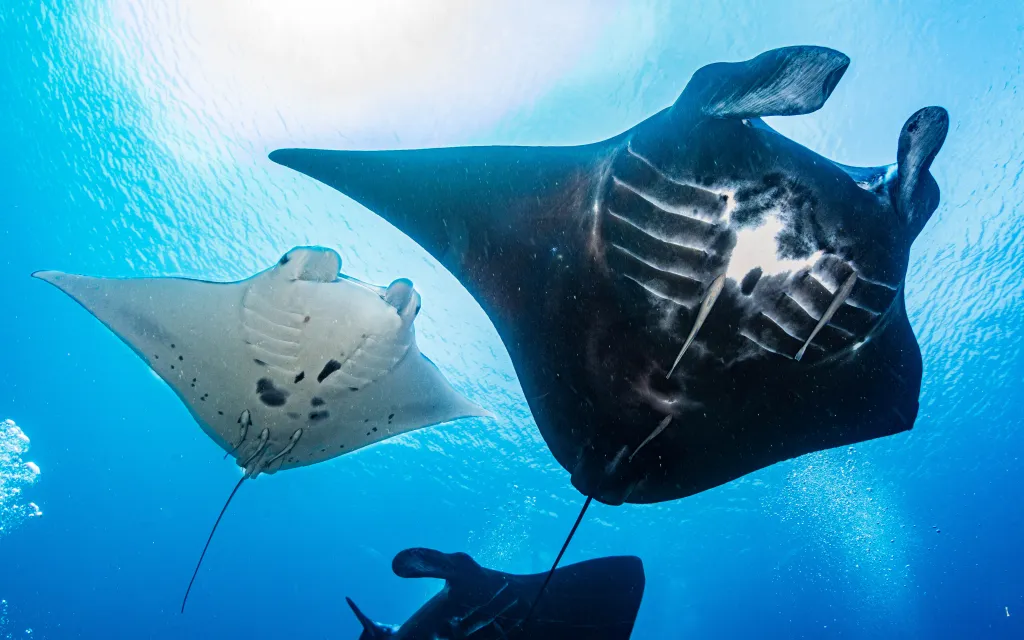
Imagine slipping into warm, turquoise waters off a remote island, your snorkel mask fogging slightly from the thrill. Suddenly, a shadow glides overhead—massive, diamond-shaped, like a living kite. It’s a manta ray, and she’s not alone. A parade of males trails her, twisting through the current in perfect sync. This isn’t just swimming; it’s a high-stakes ballet, a courtship dance that feels like nature’s own rom-com with flips and chases. I’ve chased that moment myself, heart pounding during a dive in the Maldives, and let me tell you, it sticks with you like salt on your skin. These gentle giants don’t just move—they perform, turning the ocean into a stage for one of the sea’s most mesmerizing rituals.
What Is the Manta Ray Courtship Dance?
At its core, the manta ray courtship dance is a wild, acrobatic chase where a female leads a line of eager males through the water, testing their stamina and skill. It’s like speed dating underwater, but with somersaults and speeds up to 10 km/h. Scientists call it a “courtship train,” and it’s been documented in hotspots like the Maldives, where researchers have logged over 229 events.
This ritual isn’t random—it’s evolution’s way of ensuring only the fittest mate. Females release pheromones to signal readiness, drawing males who must prove themselves. What starts as a solo flirt turns into a conga line of up to 30 rays, snaking around reefs and even breaching the surface. It’s equal parts graceful and chaotic, a reminder that romance in the wild is anything but scripted.
For divers like me, witnessing it feels intimate, almost voyeuristic. One wrong bubble, and the show scatters. But when it clicks, you’re part of something ancient and alive.
The Graceful Giants: Meet the Manta Rays
Manta rays are the ocean’s supermodels—elegant, enormous, and endlessly curious. There are two main species: the reef manta (Mobula alfredi), topping out at 5.5 meters wingspan, and the giant oceanic manta (Mobula birostris), which can stretch to 7 meters and weigh over 1,300 kg. They’re filter feeders, slurping plankton through mouths wide as dinner plates, with cephalic fins that look like rolled-up sleeves ready for action.
These aren’t your average fish; mantas boast the largest brain-to-body ratio among rays, hinting at smarts that rival dolphins. They’ve passed the mirror test for self-awareness, and they form mental maps to revisit cleaning stations. No stingers here—unlike stingrays, mantas are harmless, often approaching divers with wide-eyed curiosity, as if saying, “Join the fun?”
I remember my first encounter off Hawaii’s Kona coast: a reef manta hovered inches from my face, cephalic fins unfurling like a greeting. It was less a dive and more a dance lesson from the sea.
Reef Manta vs. Oceanic Manta: Key Differences
Both species share the courtship flair, but their worlds diverge. Reef mantas stick to coastal shallows, while oceanics roam the open blue. Here’s a quick comparison to spotlight what sets them apart.
| Feature | Reef Manta (Mobula alfredi) | Oceanic Manta (Mobula birostris) |
|---|---|---|
| Max Wingspan | Up to 5.5 meters | Up to 7 meters |
| Habitat | Coastal reefs, lagoons | Open ocean, deeper waters |
| Courtship Depth | Often 25-65 meters | Recorded up to 67 meters (deepest filmed) |
| Population Hotspot | Maldives, Indonesia | Mexico’s Revillagigedo Islands, Galapagos |
| Vulnerability | Vulnerable (IUCN) | Endangered (IUCN) |
This table underscores why protecting both matters—oceanics face bigger threats from open-sea fishing.
How the Courtship Dance Unfolds Step by Step
The dance kicks off subtly: a female, mature at 10-15 years old, releases pheromones like a siren’s call. Males detect it from afar, zeroing in with laser focus. One bold guy shadows her, rubbing cephalic fins on her back—a manta flirt that’s equal parts tender and insistent.
Soon, rivals join, forming the train. The female bolts, twisting through coral mazes, barrel-rolling, and leaping clear of the water. It’s her audition process: Can you keep up? The weak links peel off, exhausted, until one persists. If he passes, she slows near the surface. He bites her left pectoral fin gently, flips belly-to-belly, and inserts a clasper for a 30-90 second mating. Quick, but potent—she stores sperm for years, choosing when to fertilize.
It’s not always fireworks; sometimes the train fizzles without a winner. But when it works, it’s poetry in motion, a testament to patience in a fast world.
The Five Stages of Manta Wooing
Breaking it down feels like scripting a nature doc, but here’s the play-by-play from observed events.
- Pheromone Signal: Female broadcasts readiness; males swarm.
- Shadowing: Lead male mirrors her moves, cephalic fin caresses.
- Train Formation: Up to 30 males line up head-to-tail.
- The Chase: Twists, turns, breaches—stamina test supreme.
- Climax and Copulation: Bite, flip, insert; then separation.
Each stage builds tension, like waiting for the plot twist in your favorite ocean thriller.
Why This Dance Matters: Biology and Beyond
This isn’t just showy—it’s survival. Mantas breed slowly, one pup every 2-5 years after a 12-13 month gestation. The dance weeds out the unfit, boosting gene quality in a species with low fecundity. Plus, it happens near cleaning stations, where rays get pampered by wrasse fish, tying social grooming to romance.
Emotionally, it’s a window into manta intelligence. They don’t rush; courtship can span days, echoing humpback whale runs. For conservationists, it’s a red flag: Disrupt the dance with boats or nets, and populations plummet. I’ve seen stressed mantas abort trains mid-chase—heartbreaking proof of our impact.
Humor me here: If mantas had dating profiles, it’d read, “Seeking persistent partner for epic swims. No quitters.” It’s that blend of whimsy and wisdom that hooks you.
Prime Spots to Witness the Manta Magic
Dreaming of your own front-row seat? The world’s got hotspots where courtship trains parade regularly. Top pick: Hanifaru Bay in the Maldives’ Baa Atoll, a UNESCO site where plankton blooms fuel the frenzy from June to November. Dive operators like Manta Trust partners offer guided trips—book early, as entry’s capped at 180 visitors daily.
Yap Island, Micronesia, shines March to June with “dancing mantas” exploding around reefs. Off Mexico’s Revillagigedo Islands, oceanic mantas court deep—Crittercam footage from 2025 captured the deepest train yet at 67 meters. For a US vibe, Kona, Hawaii’s night dives draw reef mantas year-round, though peak courtship hits spring.
Navigational tip: Use apps like DiveMate for site maps, but always check seasonal currents.
Best Times and Places: A Seasonal Guide
Timing’s everything—here’s a pros/cons rundown for top destinations.
| Destination | Peak Courtship Season | Pros | Cons |
|---|---|---|---|
| Maldives (Hanifaru Bay) | Jun-Nov | Massive trains, snorkel-friendly | Crowds, permit limits |
| Yap, Micronesia | Mar-Jun | Explosive dances, clear viz | Remote travel, variable weather |
| Revillagigedo, Mexico | Nov-May | Deep-sea spectacles, sharks too | Liveaboard only, rough seas |
| Komodo, Indonesia | Apr-Nov | Nutrient-rich currents, dragons on land | Strong drifts, advanced divers |
| Kona, Hawaii | Year-round (peak spring) | Night dives, easy access | Higher costs, touristy |
Pro: Unmatched intimacy. Con: Respect codes—stay 3 meters back to avoid spooking the stars.
Conservation: Keeping the Dance Alive
Mant as are vulnerable, with oceanics endangered by gill plate trade for dubious Chinese meds. Overfishing, boat strikes, and plastics threaten trains—females need safe spaces to lead. Orgs like Manta Trust tag rays for tracking, pushing no-take zones. Ecuador’s Galapagos Marine Reserve protects 22,000 giants, a win worth celebrating.
My story: During a volunteer stint in Indonesia, I helped ID a scarred manta—propeller cut from a tourist boat. It fueled my advocacy; now I push eco-tours. Light humor: Mantas don’t need Tinder, but they do need us swiping left on pollution.
Transactional angle: Support via adopt-a-manta or gear like sustainable fins from PADI’s eco-shop. Best tool? Your voice—petition for bans.
People Also Ask: Your Burning Questions Answered
Google’s “People Also Ask” pulls real curiosities—here’s the scoop on manta courtship queries.
Why do manta rays dance around each other?
It’s courtship! Females lead males in synchronized swims to test agility and endurance, forming “trains” that can last hours. This display ensures strong genes, often near full moons for extra drama.
Do manta rays mate for life?
Nope, they’re polygamous speed-daters. Females store sperm from multiple males, choosing partners over years—no lifelong duets here, just epic one-offs.
How deep do manta rays court?
Reef mantas hit 25-65 meters; oceanics go deeper, with 2025 footage showing trains at 67 meters off Mexico—proving romance knows no bounds (or shallows).
Are manta ray dances dangerous to watch?
Not if you’re smart—keep distance to avoid stress. Divers report “explosions” of rays scattering, but with guides, it’s thrilling, not risky.
FAQ: Real Talk on Manta Courtship
Pulled from diver forums and searches—these hit common curiosities.
Q: What’s the longest recorded manta courtship train?
A: Up to 30 males, clocked in the Maldives. One female led them for days, turning the reef into her personal runway.
Q: Can pregnant mantas still dance?
A: Yep—some lead trains just for kicks, pheromones flowing regardless. It’s like morning yoga for moms-to-be.
Q: How do mantas choose a mate during the dance?
A: Endurance wins—last male standing gets the nod. She slows if impressed, biting ensues. No swipes, just survival.
Q: Is manta courtship seasonal everywhere?
A: Varies: Maldives peaks Oct-Apr, Yap Mar-Jun. Check local blooms—plankton parties draw the crowds.
Q: What’s the funniest part of watching manta dances?
A: The breaches! Males flop like awkward teens at prom, somersaulting to impress. Laughter bubbles up with the waves.
Final Waves: Dive Into the Dance
That first glimpse of a manta train changed me—turned a casual snorkeler into a lifelong advocate. These dances aren’t just spectacle; they’re the pulse of ocean life, fragile yet fierce. Whether you’re plotting a trip to Yap’s explosive ballets or cheering from shore, remember: Mantas teach us persistence pays, in love and conservation. So next time you’re beachside, scan the horizon. The sea’s got stories, and this one’s a blockbuster. What’s your manta moment? Share below—I’d love to hear.