Hey there, fellow ocean lover. Picture this: You’re wading into crystal-clear waters off the Great Barrier Reef, the sun warming your shoulders, and everything feels perfect. Then, out of nowhere, a faint brush against your leg sends fire racing up your skin. I’ve been there—not in Australia, mind you, but on a family snorkel trip in Hawaii a few years back. What I thought was seaweed turned out to be a sneaky jellyfish tentacle, and let me tell you, the sting had me hobbling like I’d lost a bet with a bee swarm. It wasn’t life-threatening, but it sure made me respect these drifting drifters. Jellyfish aren’t out to get us; they’re just ancient survivors doing their thing. But some pack a punch that can turn paradise into panic. In this deep dive, we’ll explore the eight most dangerous jellyfish species, plus that one sneaky imposter that looks the part but isn’t even family. We’ll cover what makes them tick, real stories from the front lines, and how to keep your beach days sting-free. Stick with me—by the end, you’ll be armed with knowledge that feels like a personal chat over piña coladas.
The Box Jellyfish: Nature’s Stealth Assassin
If there’s a poster child for deadly jellyfish, it’s the box jellyfish, or Chironex fleckeri, often called the sea wasp. This translucent terror lurks in the warm coastal waters of northern Australia and Southeast Asia, blending seamlessly with the sea like a ghostly ninja. What sets it apart? Up to 60 tentacles, each lined with millions of microscopic harpoons loaded with venom that attacks the heart, nervous system, and skin cells. A brush with one can stop your heart in minutes—talk about a bad vibe check.
I remember reading about a young lifeguard in Queensland who got tagged while patrolling. He described it as “lightning in your veins,” collapsing on the sand before his team could react. Stories like his remind us these aren’t movie monsters; they’re real, with over 60 recorded deaths since the 1880s. But here’s the silver lining: Awareness and quick action save lives every day.
The Irukandji Jellyfish: Tiny Terror with Delayed Drama
Don’t let its pinky-nail size fool you—the Irukandji jellyfish, like Carukia barnesi, is a pint-sized powerhouse from Australia’s northern coasts. These box jelly cousins drift in tropical waters, their four long tentacles trailing like invisible fishing lines. The venom? It triggers Irukandji syndrome, a sneaky reaction that hits 30 minutes post-sting: excruciating back pain, nausea, and a adrenaline surge that can burst blood vessels or flood the lungs.
One survivor’s tale hits close to home for me. A friend of a friend, a backpacker snorkeling in Cairns, felt a mild prick and shrugged it off. Two beers later, he was in the ER, sweating bullets and begging for relief as his blood pressure skyrocketed. It’s like the jellyfish ghosts you—silent but savage. Humor in hindsight? He jokes it was the universe’s way of saying “slow down, mate.” But seriously, these stings hospitalize dozens yearly.
The Lion’s Mane Jellyfish: The Gentle Giant with a Nasty Grasp
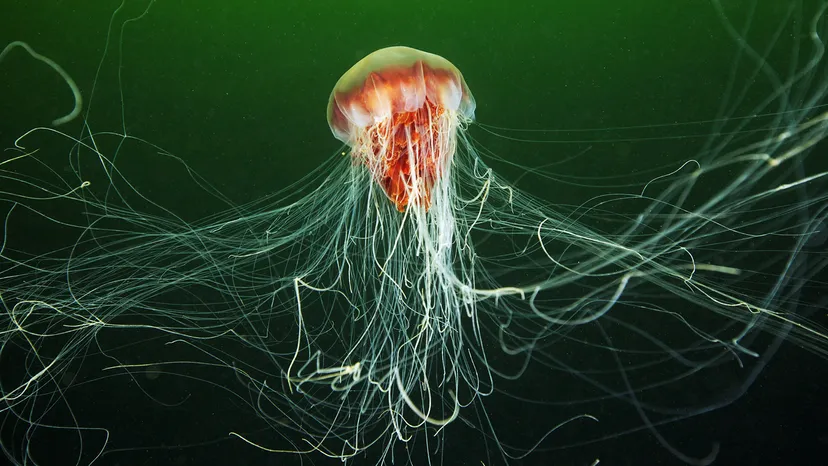
Imagine a jellyfish the size of a dinner table, with tentacles stretching 100 feet— that’s the lion’s mane, Cyanea capillata, ruling cold waters from the Arctic to the North Atlantic. Its fiery, mane-like fringe isn’t for show; those tentacles deliver a sting like hot pokers, causing welts, muscle cramps, and allergic reactions that linger for weeks.
Back in my college days, I watched a documentary about a Scottish diver who tangled with one in the chilly Firth of Forth. He emerged with arms like inflated sausages, laughing through the pain: “Felt like hugging a cactus party.” Chills and fever followed, but he pulled through with hot compresses. At up to 440 pounds, it’s the heaviest jelly, but its danger lies in sheer contact area—step on a detached tentacle on the beach, and you’re in for a rude awakening.
The Portuguese Man o’ War: The Imposter That Packs a Punch
Now for our stinging imposter—the Portuguese man o’ war isn’t a true jellyfish at all. It’s a siphonophore, a floating colony of specialized critters acting as one unit, with a gas-filled bladder like a sailboat and tentacles dangling up to 165 feet. Found in warm Atlantic and Pacific waters worldwide, its blue bubble looks innocent bobbing on waves, but those tentacles fire neurotoxins causing whip-like welts and shock.
I once spotted one washed up on a Florida beach during spring break. Kids poked it with sticks—bad idea. One got a glancing sting and spent the night icing welts that felt like fire ants at a rave. “Worst sunburn ever,” he groaned. Even dead, it stings, fooling folks into thinking it’s harmless flotsam. Nature’s ultimate prankster.
Cannonball Jellyfish: The Psychedelic Stinger
Stomolophus meleagris, the cannonball jellyfish, rolls through the Gulf of Mexico and Atlantic like pale blue beach balls, their dome-shaped bells pulsing hypnotically. Harmless to eat (harvesters snag millions yearly for Asian cuisine), but their short tentacles pack a sting causing skin irritation, hives, and in rare cases, respiratory distress—especially if you’re allergic.
A Charleston fisherman shared his story online: Brushed one while casting nets, ended up with red welts that itched for days. “Thought it was a mosquito convention,” he quipped, slathering on hydrocortisone. They’re booming due to warmer waters, turning calm bays into itchy minefields.
Sea Nettle: The Chesapeake Bay Buzzkill
Chrysaora quinquecirrha, the Atlantic sea nettle, haunts East Coast estuaries like Chesapeake Bay with its bell-shaped body and lacy oral arms. Those eight tentacles, up to 5 feet long, deliver a sting like nettles on steroids—burning pain, red streaks, and nausea that ruins a good crabbing trip.
During a kayaking outing in Maryland, my cousin flipped her boat and came up arms-first into a nettle bloom. “Like swimming through razor wire,” she texted me later, her paddle arm swollen twice over. She dunked in hot water and lived to laugh about it. Blooms here spike in summer, thanks to nutrient runoff—nature’s way of saying “ease up on the fertilizer.”
Flower Hat Jellyfish: Beauty with a Bite
Olindias formosus, the flower hat jellyfish, dazzles in Japanese and Brazilian coastal shallows with its rainbow-striped bell and frilly tentacles that wave like party streamers. But touch one, and its sting brings blistering pain, headaches, and muscle spasms—enough to sideline divers for days.
A Brazilian surfer’s GoPro footage went viral: He high-fived a hat mid-wave, only to bail paddling frantically, face twisted in agony. “Prettiest nightmare ever,” he captioned it. Climate shifts are pushing them poleward, surprising beachgoers who expect postcard vibes.
Nomura’s Jellyfish: The Massive Marauder
Nemopilema nomurai, the Nomura’s jellyfish, is a behemoth of the Sea of Japan and Yellow Sea, weighing up to 440 pounds with a 6.5-foot bell. Its sting causes swelling, shock, and in extremes, cardiac issues—fishermen’s worst foe during blooms that shred nets.
In 2005, a massive bloom stranded thousands on Namhae Island beaches. One fisherman, stung hauling a catch, described it as “a truck running over your arm.” He recovered with antihistamines, but the economic hit was brutal—millions in lost gear. Overfishing removes their predators, letting these giants party unchecked.
Morbakka Fenneri: The Fire Jelly Fury
Morbakka fenneri, or fire jelly, simmers in Queensland’s warmer waters, its boxy bell hiding tentacles that unleash a burn like acid on skin. Symptoms ramp up to fever and chills, mimicking flu but with a seaside twist—rarely fatal, but no picnic.
A local diver in my network got zapped during a night dive. “Felt like I swallowed hot sauce whole,” he shared over beers, showing off faded scars. Quick vinegar rinse saved the day. It’s the underdog danger, thriving in the shadow of bigger box kin.
How Jellyfish Stings Work: The Nematocyst Nightmare
At the heart of every jellyfish’s defense is the nematocyst—a coiled harpoon in their tentacles that fires faster than a .22 bullet when triggered by touch or chemicals. Venom varies: Some shred cells, others fry nerves or spike blood pressure. For humans, it’s often the chaos—pain signals overwhelming your brain—that does the real damage.
Think of it like a microscopic ambush: One tentacle contact, and thousands deploy, injecting toxin in milliseconds. My Hawaii mishap? Mild by comparison, but it taught me respect for these evolutionary holdovers from 500 million years ago. Understanding this demystifies the fear, turning “what if” into “how to handle.”
Venom Types Across Species
Jellyfish venom isn’t one-size-fits-all; it’s a cocktail tailored to each species’ prey.
- Cardiotoxins (box jelly): Target heart muscle, causing arrest.
- Neurotoxins (Irukandji): Overstimulate nerves for delayed agony.
- Hemolysins (lion’s mane): Burst red blood cells, leading to swelling.
This variety explains why no single antidote rules them all—yet.
Real-Life Encounters: Stories from the Sting Front
Nothing drives home danger like survivor tales. Beyond my brush, consider 17-year-old Maya Merhige’s 2023 Cook Strait crossing: Thousands of stings from nameless jellies turned her 14-hour triumph into a welted war story. “Out of sight, out of mind,” she quipped, but the mental grit? Inspiring.
Or the 2010 Langkawi cruiser stung by an Irukandji: Mild at first, then hours of hellish cramps. He credits crew vinegar for pulling him through. These aren’t urban legends; they’re wake-up calls with heart.
Treatment: From Vinegar to ER Dash
First rule: Exit the water calmly—no flailing to spread the love. Rinse with seawater or vinegar (for most tropical stings) to neutralize unfired nematocysts; skip freshwater, which triggers more. Hot water (as hot as tolerable, 104-113°F) eases pain by breaking down venom proteins—20 minutes minimum.
For severe cases like box stings, antivenom awaits at hospitals. My go-to? Over-the-counter hydrocortisone for itch, plus monitoring for anaphylaxis. Always err ER-side if breathing hitches.
Step-by-Step First Aid Guide
- Rinse: Seawater or vinegar, 30 seconds.
- Remove tentacles: Tweezers or edge of a card—gloves on.
- Deactivate: Hot water immersion.
- Soothe: Ice after, then cream.
Simple, right? But timing is everything.
Prevention: Gear Up Before You Dive In
Want to swim sting-free? Layer up. Stinger suits or rash guards cover skin; full-body wetsuits for high-risk spots like Aussie reefs. Check local flags—purple means “dangerous marine life.”
Apps like JellyWatch crowdsource sightings, while commercial sprays (Safe Sea) coat skin to block nematocysts. Pro tip: Shuffle feet in shallows to scare off lurkers. It’s like ocean yoga—peaceful prep for adventure.
Best Protective Gear Comparison
| Gear Type | Pros | Cons | Best For | Price Range |
|---|---|---|---|---|
| Stinger Suit | Full coverage, breathable | Less stylish | Tropical dives | $50-100 |
| Rash Guard | Quick-dry, UV block | Arms/legs exposed | Casual swims | $20-40 |
| Safe Sea Spray | Easy apply, reef-safe | Needs reapplication | Snorkeling | $15-25 |
| Wetsuit | Thermal + protection | Bulky | Cold waters | $100-200 |
Pick based on your spot—Hawaii’s Alatina alata swarms? Spray and suit up.
Pros and Cons: Loving the Ocean Despite the Stings
Pros of exploring jellyfish territory:
- Biodiversity bliss: Thrives ecosystems we adore.
- Adventure edge: Builds resilience, stories for life.
- Eco-insight: Sparks conservation chats.
Cons, though:
- Pain payoff: Instant regret potential.
- Health hits: Allergic risks linger.
- Eco-worries: Warming waters amp blooms.
Balance it: Educate, protect, respect. The sea’s worth the savvy swim.
People Also Ask: Your Burning Questions Answered
Google’s “People Also Ask” pulls real curiosities—here’s the scoop on dangerous jellyfish queries.
What is the most venomous jellyfish?
The Australian box jellyfish tops the list, with venom potent enough to kill in minutes via heart failure. It’s not just sting strength; delivery speed seals the deal.
Are all jellyfish stings dangerous?
Nope—most cause mild irritation, like 90% of U.S. encounters. True threats are rare, tied to specific species in tropics. Know your waters.
How do you treat a jellyfish sting at home?
Rinse with vinegar, hot water soak, remove bits gently. OTC pain relief follows—no peeing on it, myth busted. ER if systemic symptoms hit.
Where are box jellyfish found?
Primarily Indo-Pacific coasts: Australia, Philippines, India. Avoid November-May peaks. Signs and suits are your friends.
Can jellyfish stings be fatal?
Yes, but rarely—about 1-2% of severe cases, mostly box or Irukandji. Quick care flips the script.
FAQ: Tackling Top User Queries
Got questions? These pop up in searches daily—let’s clear the water.
Q: What’s the best tool for preventing jellyfish stings?
A: Hands-down, a full-coverage stinger suit from dive shops like Divers Direct. Pair with Safe Sea spray for 80%+ reduction—lab-tested magic. For buys, check Amazon’s top-rated options.
Q: How long does a jellyfish sting last?
A: Mild ones fade in hours; severe welts linger weeks. Hot water cuts time—my Hawaii zap? Gone in 48 with cream.
Q: Are jellyfish blooms getting worse?
A: Yep, warming oceans and pollution fuel them. Track via NOAA’s forecasts for safe swims.
Q: Can you eat jellyfish after a sting risk?
A: Cannonballs are delicacy-safe, but skip if allergic. Rinse well; they’re harvested sting-free.
Q: What’s Irukandji syndrome exactly?
A: Delayed venom reaction: Pain wave, hypertension, potential brain bleed. Vinegar first, then hospital—don’t tough it out.
There you have it—the jelly world’s wild side, wrapped in stories and smarts. Next beach trip, you’ll spot the fakers, dodge the dangers, and dive deeper with confidence. What’s your ocean tale? Drop it below—I’d love to hear. Stay salty, friends.